

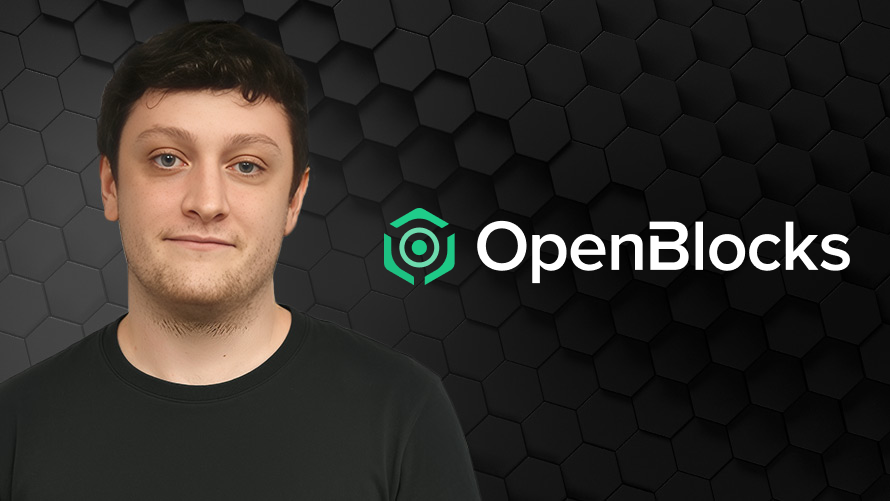
On the March 12th episode of The SUP, Chase and James were joined by Brayden Abick, founder of Blockpour, a blockchain analytics startup that was recently acquired by Supra and rebranded as OpenBlocks.ai. In this article, we’ll touch on highlights from their hour-long conversation, which covered everything from whale tracking and copy-trading to AI agents, rugs, and the future of cross-chain DeFi.
From Blockpour to OpenBlocks.ai
Blockpour originally launched as a multi-chain data aggregation and analytics platform intended to simplify cross-chain navigation for users. The platform primarily operated as a data provider, selling API access to projects that needed multi-chain feeds for dashboards and tools.
With the acquisition by Supra, the rebrand to OpenBlocks.ai signals a shift:
- Moving from just providing data to building applications and tools on top of that data.
- Integrating with Supra’s IntraLayer architecture, automation, and oracles.
- Enhancing both developer APIs and end-user tools for the broader Supra ecosystem.
Brayden emphasized that OpenBlocks will empower users to explore Supra’s on-chain activity more intuitively, while also giving projects access to rich data feeds through APIs.
Demo: Following Funds and Exploring Wallets
During the show, Brayden shared a live demo of OpenBlocks in action. Using a Bybit wallet as an example, he showed how users can:
- Trace deposits and withdrawals across Supra starting from Genesis (Nov. 27).
- Put any wallet in focus and follow the flow of funds step by step.
- Filter transactions by specific time ranges (days, weeks, months).
- Track whale behavior or monitor personal transactions with ease.
The sleek UX and smooth UI impressed both the hosts and the audience. As Chase noted:
“That’s the nicest UI/UX I’ve ever seen for a data website; the small details make it feel premium.”
Copy-Trading & Wallet Tracking: Promise and Risk
One of the hottest topics was copy-trading via AI agents. The idea: find a profitable wallet and automatically replicate its trades. Brayden cautioned that while this is possible, it’s also risky:
- A wallet might perform actions (e.g., locking tokens, creating liquidity pools) that followers wouldn’t want.
- If whales realize they’re being copied, they could set traps by rug-pulling liquidity pools.
- AI agents need conditional logic (e.g., avoiding brand-new pools) to mitigate risks.
In other words, copy-trading is powerful, but without safeguards, it’s a recipe for disaster.
Can AI Agents Spot Rugs Before They Happen?
Brayden explained that Blockpour (and now OpenBlocks) had already been flagging rug-pull risks even before AI integration. For example:
- Liquidity concentration: A pool with $25M from one provider is far riskier than $5M from 10,000 providers.
- Deployers with history: If a wallet has launched multiple tokens, it’s likely a serial rugger.
- Correlation analysis: Following funding sources can reveal hidden links between wallets, exposing rug networks.
By training AI agents on these datasets, OpenBlocks can help users avoid becoming exit liquidity in meme coin markets.
Beyond Copy-Trading: AI Agents & Trusted Data
Brayden highlighted the importance of trusted data feeds for AI agents. Current agents often scrape the open web (e.g., by typing into Google or scanning Zillow), which can be slow and unreliable. The future lies in:
- Agent-to-agent communication: AI agents exchanging specialized knowledge directly.
- Agent-to-data feeds: Querying verified APIs (like OpenBlocks) for real-time, accurate crypto data.
This vision aligns perfectly with Supra’s infrastructure, where oracles and IntraLayer provide secure, high-quality data pipelines for AI systems.
The Zero-Sum Question: Will AI Change Markets Forever?
James posed a provocative question:
“If all traders eventually use AI agents, and markets are zero-sum, who loses?:”
Brayden’s take:
- Asymmetry will persist. Prop firms and hedge funds already have algos and will always have more resources than retail.
- Retail can improve. AI agents may help minimize losses and identify niche opportunities (e.g., in meme coins or small-cap DeFi) where big traders can’t deploy significant capital.
- Emotions matter. AI could help retail avoid emotional mistakes, one of the biggest edges professionals have today.
In short, AI won’t level the playing field, but it may reduce retail’s disadvantage and unlock new opportunities.
Cross-Chain Simplification with Supra’s IntraLayer
One of the biggest unlocks of the acquisition is the combination of OpenBlocks and Supra’s IntraLayer. For users, this means:
- Abstracting complexity: Instead of learning to bridge, swap, and search across chains, users can simply ask OpenBlocks, “Where can I earn yield on my stablecoins?” and let the system handle execution.
- Safer automation: Agents can use Supra’s vaults, automation, and oracles to ensure execution is secure and price feeds are reliable.
- Best pricing logic: OpenBlocks knows liquidity across chains, meaning it can route trades to minimize slippage for different trade sizes.
As Brayden put it:
“With Blockpour, we had the data. With Supra, we finally have the infrastructure to execute on it.”
A New Era: AI + DeFi + Cross-Chain
Looking ahead, Brayden described the OpenBlocks vision as bringing more users into DeFi by radically simplifying access. By lowering the barrier to entry, more liquidity and TVL will flow into protocols, incentivizing further innovation and creating a flywheel effect.
James summed it up:
“So few people in crypto truly understand DeFi. Making it accessible to both Web3 natives and newcomers, even someone like my dad, is game-changing.”
Closing Thoughts
Looking forward, Brayden sees OpenBlocks as part of a bigger flywheel effect:
- Simplified access attracts more users to DeFi.
- More users = higher TVL across protocols.
- Higher TVL attracts more builders, who create more efficient apps.
In short, AI + Supra + OpenBlocks could help DeFi break out of its current niche and reach a far larger audience.
Want to get started?
- Check out OpenBlocks.ai.
- Download StarKey Wallet to stake your Supra.
- Join new live episodes of The SUP every Thursday at 3 p.m. UTC.